


The African Development Bank is building a continent-wide platform to mobilise capital for airlines, aircraft, infrastructure and aviation reform. Its target is US$7 billion over five years, but the institution is not proposing to fund that amount from its own balance sheet.
The African Development Bank (AfDB) has set out how its Integrated Aviation Transformation Program for Africa (IATP) will seek to mobilise US$7 billion over the next five years, using guarantees, blended-finance structures and partnerships to draw private and institutional capital into the continent’s aviation sector.
Speaking to African Pilot Magazine Editor Phillippa Dean during the inaugural African Air Transport Convention & Expo 2026 in Lomé, AfDB Transport and Logistics Division Manager Marco Yamaguchi stressed that the figure is a mobilisation target rather than a commitment by the Bank to invest the entire amount itself.
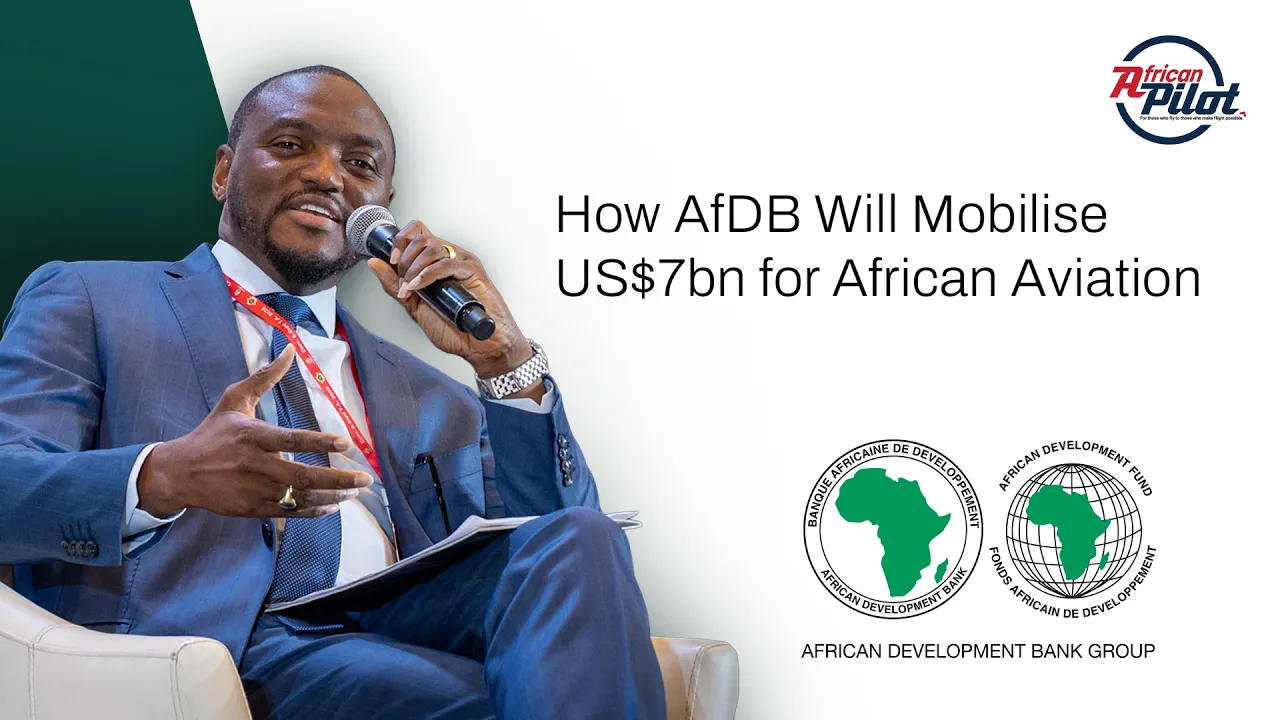
The Bank intends to act as a catalyst, working with development finance institutions, commercial banks, aircraft lessors, institutional investors and other partners. Yamaguchi said AfDB already has more than US$7 billion in the project pipeline.
AfDB’s financing mechanisms are intended to support eligible public and private airlines, reflecting the different structures of aviation markets across Africa. Alongside the funding component, the Bank sees stronger competition and market liberalisation as essential to improving airline performance and lowering the cost of air travel.
Three Pillars Cover the Wider Aviation System
IATP is structured around three pillars, beginning with the enabling conditions required for aviation investment and growth.
The first covers policy and regulatory reform, safety, security, sustainability and capacity building. This includes institutional and technical work that may not involve direct asset financing but is necessary to strengthen oversight, develop skills and create a more investable operating environment.
Infrastructure forms the second pillar. While AfDB has historically financed airport terminals and runways, the new programme broadens the scope to encompass the wider aviation ecosystem. Yamaguchi identified cargo terminals, maintenance, repair and overhaul facilities, air navigation and surveillance systems, aviation fuel infrastructure, sustainable aviation fuel, airport cities and rail connections between airports and urban centres.
He confirmed that technologies associated with air traffic control, surveillance, communications and airport security fall within this pillar. AfDB is considering a pipeline operation involving the Agency for Air Navigation Safety in Africa and Madagascar (ASECNA), demonstrating that the programme’s infrastructure definition extends beyond physical airport buildings.
The third pillar is aircraft and fleet modernisation. It is intended to support access to aircraft through a range of financing structures, including facilities capable of helping airlines acquire or lease newer equipment.
Reducing the Risk Premium
A central part of the financing model will be the use of guarantees to reduce the credit risk faced by commercial financiers and aircraft leasing companies entering African markets.
One mechanism under development is a risk-sharing facility supported by first-loss protection. Japan is the first donor to IATP and has committed support towards establishing the mechanism. By absorbing an initial layer of potential loss, the structure is intended to improve the risk profile of transactions and attract institutions that are interested in African aviation but have been constrained by credit concerns.
The approach addresses a persistent disadvantage for African operators and infrastructure developers, which frequently pay more for capital, insurance, equipment and services because projects and counterparties on the continent are assigned a higher level of risk.
AfDB’s model is designed to use a comparatively limited amount of guarantee capital to mobilise a much larger pool of commercial funding. The Bank is also considering other instruments, including bonds and guarantee facilities, rather than relying solely on conventional project loans.

AfDB Director of the Infrastructure and Urban Development Department Mike Salawou said this platform approach would also be linked to the New African Financial Architecture for Development (NAFAD). Through NAFAD, the Bank aims to bring together African development finance institutions, pension funds, insurers and other pools of domestic capital, while continuing to work with international financiers.
Bishoftu Tests the Project-Finance Model
Ethiopia’s Bishoftu International Airport illustrates the scale and structure of the projects AfDB expects to support.
Salawou said the estimated cost of the airport programme had reached approximately US$12.5 billion, of which AfDB, as mandated lead arranger, is expected to mobilise around US$8.5 billion.
Crucially, the funding is being structured as a standalone private-sector project-finance operation. According to Salawou, neither direct Ethiopian government funding nor a sovereign guarantee is envisaged. Lenders will assess the project on its underlying economics, including Ethiopian Airlines’ network, Addis Ababa’s role as a continental and intercontinental transfer hub, and forecast demand.
AfDB is bringing together development finance institutions, export credit agencies and other prospective funders from Africa, Asia, Europe and the United States.
The transport links serving the new airport form part of the same planning exercise. Bishoftu must be connected efficiently with Addis Ababa and the existing Bole International Airport, which will continue to have a role in Ethiopia’s wider aviation system. Road and rail links are planned to provide a seamless corridor between the two airports and the city, allowing passenger flows and airport functions to be distributed across the system.
This integrated approach is significant, airport capacity cannot be treated separately from the ground transport required to move passengers, employees and cargo, particularly when a new hub is built beyond the existing urban footprint.
Liberalisation Remains Part of the Investment Case
Capital alone will not resolve the structural constraints affecting African aviation. AfDB is supporting the Single African Air Transport Market (SAATM) and the implementation of the Yamoussoukro Decision through technical assistance and its partnership with the African Civil Aviation Commission (AFCAC).
The Bank’s first IATP pillar is intended to reinforce that work by helping member states address regulatory reform, market access, institutional capacity and the freedom rights required for a more integrated African air transport market.
For air cargo, greater use of seventh-freedom rights would allow an airline from one country to carry freight between two other countries without routing the service through its home state. This flexibility is particularly relevant to the African Continental Free Trade Area, where the movement of time-sensitive and higher-value goods depends on practical air links rather than policy commitments alone.
Salawou said AfDB’s airport portfolio already includes projects in Morocco, Tanzania, the Central African Republic, Senegal and Uganda. Under IATP, the Bank intends to place greater emphasis on modernising airports, improving safety and regulatory compliance, upgrading runways and expanding cargo infrastructure.
The strategic shift is from financing individual airport assets to supporting an aviation system. Airlines, fleets, regulation, skills, fuel supply, cargo handling, air navigation, airport access and market liberalisation are being brought into a single investment framework.

Watch the full interview filmed at the inaugural African Air Transport Convention & Expo 2026, organised by the African Civil Aviation Commission in partnership with the African Union Commission, the AfCFTA Secretariat and AUDA-NEPAD here:
Read more about New African Financial Architecture for Development (NAFAD, formerly NAFA) here: https://www.afdb.org/en/news-and-events/press-releases/afdbs-new-african-financial-architecture-development-gets-bold-start-abidjan-meeting-92310


![[© General Atomics AeroTec Systems]](https://bunny-wp-pullzone-itv8lptsts.b-cdn.net/wp-content/uploads/2026/09/Do228NXT_Key_Visual_2026-scaled-1-1920x1241.jpg)
