


Eswatini and Togo have signed an air service agreement that establishes the regulatory foundation for future passenger, cargo and trade-related air transport activities between the two countries.
The agreement was signed during the inaugural African Air Transport Convention & Expo 2026 in Lomé, where ministers from both countries were present. The convention was organised by the African Civil Aviation Commission in partnership with the African Union Commission, the AfCFTA Secretariat and AUDA-NEPAD.
Speaking to African Pilot Magazine Editor Phillippa Dean at the event, Eswatini Civil Aviation Authority Director General Andile Mtetwa-Amaeshi said the two countries had already reached an initial understanding, with the formal signature remaining outstanding.
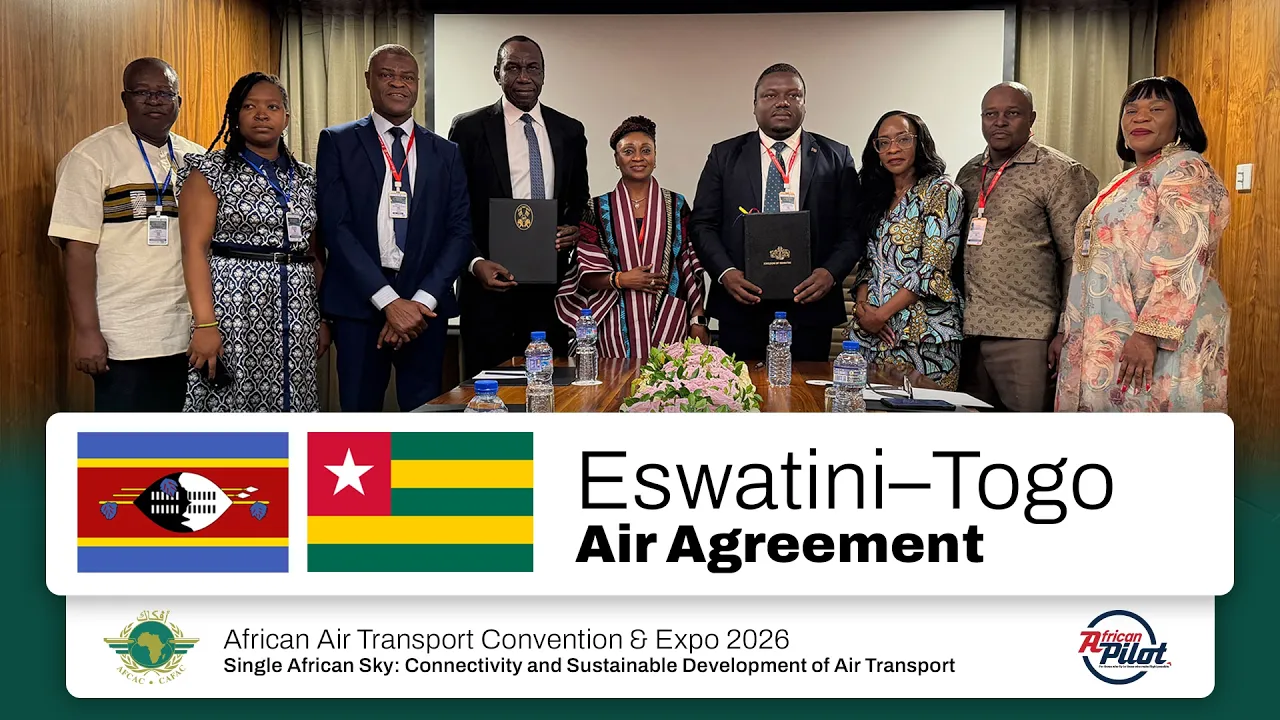
The presence of both ministers in Lomé provided an opportunity to complete the agreement and establish the framework required for any future air services between Eswatini and Togo.
Mtetwa-Amaeshi described an air service agreement as the foundation on which subsequent aviation activity is built. While the agreement does not mean that direct services will begin immediately, it creates the legal and economic basis for airlines to consider future passenger or cargo operations.
“When you build a house, you start to lay the foundation. The ASA is the foundation for every other thing that happens in terms of air transport activities,” she said.
The agreement is intended to ensure that the required bilateral framework is already in place should commercial opportunities emerge. These could include passenger services, cargo movements or trade flows between the two countries.
Mtetwa-Amaeshi said the future direction of trade and air transport demand cannot always be predicted. Establishing agreements in advance allows countries and airlines to respond more quickly when viable opportunities arise, rather than beginning bilateral negotiations only after demand has been identified.
“What we’re doing is we’re just laying the foundation for any activities that may happen later, whether in terms of air transport, in terms of cargo, in terms of trade,” she said.
The agreement also supports the broader objective of strengthening intra-African trade. Mtetwa-Amaeshi noted that air transport and the ease of moving people and goods are central to enabling stronger commercial relationships between African countries.

Any airline seeking to operate between Eswatini and Togo would, however, still need to complete a separate approval process.
The air service agreement addresses the economic and bilateral rights governing operations, but it does not replace the safety, security and regulatory requirements applicable to foreign operators.
An Eswatini-based airline seeking to operate to Lomé would need to apply to the Togolese authorities for a foreign operator’s permit and demonstrate compliance with the required safety and security standards. The same process would apply to a Togolese airline seeking to operate to Eswatini.
Mtetwa-Amaeshi said the bilateral agreement must be in place before an airline can begin the operational approval process.
“This just serves as the basis for the air transport economics around that. Then there’s still the safety requirements that would be required, but you can never start that process without this,” she said.
The agreement provides for fifth freedom passenger rights and seventh freedom cargo rights. These provisions establish the traffic rights that could shape future airline operations and cargo services under the bilateral framework.
Mtetwa-Amaeshi said Eswatini’s air service agreements are aligned with the Single African Air Transport Market and follow the applicable agreement template.
She added that Eswatini generally favours liberal air service arrangements because the country is seeking to encourage aviation activity rather than protect an established market.
“Most of the agreements we sign are fifth freedom for passengers and seventh freedom for cargo,” she said.
The Eswatini–Togo agreement does not confirm the launch of a route by either country’s airline. It does, however, remove an important bilateral obstacle by establishing the legal framework under which future services could be considered.
For Eswatini, the agreement forms part of a wider approach to creating the conditions required for stronger African air connectivity, cargo development and trade. It also reflects the role of aviation within the broader transport networks needed to support the movement of people and goods across the continent.


